
Find your kiln
Match a kiln to what you fire, the power you have and the room you need.
In stock. In stock kilns are first come, first served.
 Cone 10 · 240/208 V
Skutt KMT1027-3
The KM1027-3 with the touchscreen controller.Top-loading · 6.4 cu ft$6,039Regular price $7,205In stockPackage with vent, shelves and posts Cone 10 · 240/208 V
L&L e23T-3 Easy-Fire
A top seller for classroom and studio stoneware.Top-loading · 6.7 cu ft$6,029Regular price $7,095In stockPackage with vent, shelves and posts Cone 10 · 240/208 V
Skutt KMT822-3
Touchscreen controller with Wi-Fi firing updates.Top-loading · Small studio$4,239Regular price $5,005In stock: 240/1Package with vent, shelves and posts Cone 10 · 240/208 V
Skutt KM1027-3
Skutt’s even-firing workhorse with a lid lifter.Top-loading · 6.4 cu ft$4,587Regular price $5,250In stock: 208/3Kiln only Cone 10 · 240/208 V
Skutt KM818
The classic home-studio Skutt in 2.5 inch brick.Top-loading · Small studio$2,699Regular price $2,940In stock: 240/1Kiln only Cone 10 · 240/208 V
Skutt KM822
The taller 822 in 2.5 inch brick for bigger pots.Top-loading · Small studio$2,899Regular price $3,215In stock: 240/1Kiln only Cone 10 · 240/208 V
L&L e23M-3 Easy-Fire
The wide e23 in a middle height, 22.5 inches tall inside.Top-loading · 5.5 cu ft$5,579Regular price $6,595In stock: 240/1 and 208/1Package with vent, shelves and posts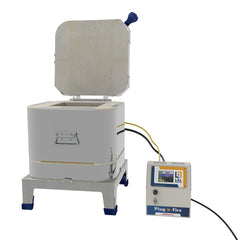 Cone 10 · 120 V
L&L Plug-n-Fire
Cone 10 from a standard 120 V outlet. A small front-door kiln.Front-loading · 0.33 cu ft$1,499Regular price $1,890In stockPackage with shelf and posts Cone 10 · 240/208 V
Skutt KMT1022-3
Wide and only 22 inches deep, with the touchscreen controller.Top-loading · Medium studio$5,659Regular price $6,705Package with vent, shelves and posts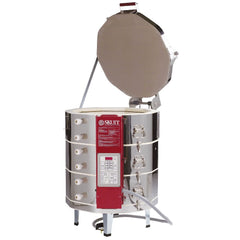 Cone 10 · 240/208 V
Skutt KM1027
The busy-studio 1027 in 2.5 inch brick.Top-loading · Medium studio$4,445Regular price $5,060In stock: 240/1 and 208/1Kiln only Cone 10 · 240/208 V
Skutt KMT1027-3
The KM1027-3 with the touchscreen controller.Top-loading · 6.4 cu ft$4,869Regular price $5,640In stockKiln only Cone 10 · 240/208 V
L&L e18M-3 Easy-Fire
The e18 in a medium height for taller pots.Top-loading · Small studio$4,139Regular price $4,815In stock: 240/1 and 208/1Package with vent, shelves and posts Cone 10 · 240/208 V
Skutt KM818-3
A popular home-studio size with 3 inch brick.Top-loading · Small studio$2,813Regular price $3,085In stock: 240/1Kiln only Cone 10 · 240/208 V
Skutt KM822-3
A taller home-studio kiln with 3 inch brick.Top-loading · Small studio$3,029Regular price $3,380In stock: 240/1Kiln only Cone 10 · 240/208 V
Skutt GlazeTech
14.5 inch square test kiln. Fires glass and metal clay too.Top-loading · Test size$2,099Regular price $2,330In stockKiln only Cone 10 · 240/208 V
L&L e23S-3 Easy-Fire
Wide 23 inch chamber at a comfortable loading height.Top-loading · Medium studio$5,099Regular price $6,015In stock: 240/1Package with vent, shelves and posts Cone 10 · 240/208 V
Skutt KMT1227-3PK
Heavy loads and fast turnaround, with the touchscreen.Top-loading · Large$6,369Regular price $7,495In stock: 240/1 and 208/3Kiln only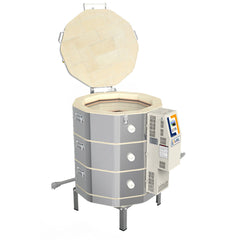 Cone 10 · 240/208 V
L&L e23T-3 Easy-Fire
A top seller for classroom and studio stoneware.Top-loading · 6.7 cu ft$4,789Regular price $5,535In stockKiln only Cone 10 · 240/208 V
L&L e18S-3 Easy-Fire
Hard ceramic element holders for long element life.Top-loading · Small studio$3,919Regular price $4,525In stock: 240/1Package with vent, shelves and posts Cone 6 · 120 V
Skutt FireBox 8x6 LT
Ceramics to cone 6, glass and metal clay from a household outlet, shelf kit included.Top-loading · 0.22 cu ft$1,349Regular price $1,490Kiln only Glass · 120 V
Paragon Quikfire 6
A tiny, fast-firing glass kiln for jewelry and pendants.Top-loading · Test size$699Regular price $750Kiln only Cone 10 · 240/208 V
L&L e28M-3 Easy-Fire
Wide 28 inch chamber with room for tall work.Top-loading · 8.5 cu ft$6,399Regular price $7,510In stockPackage with vent, shelves and posts Cone 10 · 240/208 V
Cone Art GX2327D
Double-wall insulation saves power on every cone 10 firing.Top-loading · 7 cu ft$6,429Regular price $7,692In stockPackage with vent, shelves and posts Cone 8 · 240/208 V
Skutt KM1227-3
28 inches wide, for high production. Cone 5 on 208/1.Top-loading · 9.9 cu ft$5,319Regular price $6,100In stock: 240/1Kiln only


We couldn’t load the kilns just now.
How to choose a kiln
Four questions narrow the choice to a handful of kilns. The finder above asks the same four.
- What will you fire? Most pottery is fired to cone 06–04 (low fire), cone 5–6 (mid-range) or cone 10 (high fire). Glass fusing, metal clay, knife steel and raku each have kilns built for them.
- How hot? Choose a kiln rated a cone or two above your usual firing. Many potters who fire to cone 6 buy a cone 10 kiln, because it still reaches cone 6 easily as its elements wear.
- What power do you have? A 120 V kiln plugs into a household outlet, but every 120 V pottery kiln we carry is a small test kiln under 1.5 cubic feet. Larger kilns need a dedicated 240 V or 208 V circuit. Homes almost always have 240 V. Schools and commercial buildings often have 208 V, sometimes three-phase. Confirm yours with your electrician or power company before you order.
- How big? Size the kiln for your largest piece and how often you fire, since you’ll often fire it partly full. Top-loading kilns are the most common. Front-loading kilns save bending but cost more.
Most kilns ship by freight to the curb. When you order, we’ll ask you to complete our equipment ordering checklist to confirm delivery and power. Not sure? Contact us and we’ll help you choose.
Common questions
Can I run a kiln on a regular outlet?
Yes, a small one. Our 120 V kilns plug into a household outlet and suit test tiles, jewelry and small pieces. Check each listing for the circuit it needs, and don’t share that circuit with other appliances.
What kiln do I need for cone 6?
Any kiln rated cone 6 or higher. A cone 8 or cone 10 kiln gives you headroom as its elements age. In the finder, set Hottest firing to “Mid-range · cone 6”.
Do I need a vent?
For a kiln indoors, we recommend one. A downdraft vent draws fumes out of the kiln and outdoors while it fires. Our ready-to-fire packages include a vent, shelves and posts, or browse our kiln vents.
Is a 208 V kiln the same as a 240 V kiln?
No. Many models come in both versions. A 240 V kiln on 208 V power gets about a quarter less heat, so it fires slowly and may not reach full temperature. Order the voltage your building has.